


Private Markets
Private markets describe investments beyond the stock exchange — from private companies and infrastructure to credit and real assets — offering investors exposure to long-term value creation and economic growth.
What are private markets?
Private markets form a layered ecosystem of capital, strategies, and structures — each serving distinct stages of business growth and investor objectives.
Private Markets
Private markets describe investments beyond the stock exchange — from private companies and infrastructure to credit and real assets — offering investors exposure to long-term value creation and economic growth.
What are private markets?
Private markets form a layered ecosystem of capital, strategies, and structures — each serving distinct stages of business growth and investor objectives.
Private Markets
Private markets describe investments beyond the stock exchange — from private companies and infrastructure to credit and real assets — offering investors exposure to long-term value creation and economic growth.
What are private markets?
Private markets form a layered ecosystem of capital, strategies, and structures — each serving distinct stages of business growth and investor objectives.
Private markets represent a vast and layered ecosystem
Private markets are a layered ecosystem of capital, strategies, and structures — each serving different stages of business growth and investor goals.
There are over 70 different strategies









Private markets represent a vast and layered ecosystem
Private markets are a layered ecosystem of capital, strategies, and structures — each serving different stages of business growth and investor goals.
There are over 70 different strategies
Private markets represent a vast and layered ecosystem
Private markets are a layered ecosystem of capital, strategies, and structures — each serving different stages of business growth and investor goals.
There are over 70 different strategies
Each investment serves a unique purpose
From early-stage venture to late-stage buyouts and infrastructure, each layer operates with distinct timelines, risk profiles, and return mechanics — serving its own unique purpose in the financial ecosystem and the investor’s portfolio.

Venture Capital
Early-stage funding that fuels innovation by backing start-ups and scale-ups.

Secondaries
Buying and selling existing fund stakes to access maturing private assets.

Growth Equity
Capital for proven ventures to expand, scale and reach next stage of growth.

Private Credit
Direct lending solutions offering steady income and flexible business financing.

Buyout
Acquiring established businesses to enhance efficiency, expand into new markets, and improve profitability.

Infrastructure
Building long-term value through essential infrastructure — from power and transit to connectivity.
Each investment serves a unique purpose
From early-stage venture to late-stage buyouts and infrastructure, each layer operates with distinct timelines, risk profiles, and return mechanics — serving its own unique purpose in the financial ecosystem and the investor’s portfolio.
Venture Capital
Early-stage funding that fuels innovation by backing start-ups and scale-ups.
Secondaries
Buying and selling existing fund stakes to access maturing private assets.
Growth Equity
Capital for proven ventures to expand, scale and reach next stage of growth.
Private Credit
Direct lending solutions offering steady income and flexible business financing.
Buyout
Acquiring established businesses to enhance efficiency, expand into new markets, and improve profitability.
Infrastructure
Building long-term value through essential infrastructure — from power and transit to connectivity.
Each investment serves a unique purpose
From early-stage venture to late-stage buyouts and infrastructure, each layer operates with distinct timelines, risk profiles, and return mechanics — serving its own unique purpose in the financial ecosystem and the investor’s portfolio.
Venture Capital
Early-stage funding that fuels innovation by backing start-ups and scale-ups.
Secondaries
Buying and selling existing fund stakes to access maturing private assets.
Growth Equity
Capital for proven ventures to expand, scale and reach next stage of growth.
Private Credit
Direct lending solutions offering steady income and flexible business financing.
Buyout
Acquiring established businesses to enhance efficiency, expand into new markets, and improve profitability.
Infrastructure
Building long-term value through essential infrastructure — from power and transit to connectivity.
How does a private market investment work?
It depends — every private market investment works a little differently. Each has its own mechanics, timelines, and ways of creating value. That’s what we call an investment strategy.
To understand any investment strategy, start with three key questions:
What am I investing in?
The underlying asset generating the return
How is the investment generating return?
The strategy used to generate value
When will I see a return on my investment?
Payment timelines and frequency
How does a private market investment work?
It depends — every private market investment works a little differently. Each has its own mechanics, timelines, and ways of creating value. That’s what we call an investment strategy.
To understand any investment strategy, start with three key questions:
What am I investing in?
The underlying asset generating the return
How is the investment generating return?
The strategy used to generate value
When will I see a return on my investment?
Payment timelines and frequency
How does a private market investment work?
It depends — every private market investment works a little differently. Each has its own mechanics, timelines, and ways of creating value. That’s what we call an investment strategy.
To understand any investment strategy, start with three key questions:
What am I investing in?
The underlying asset generating the return
How is the investment generating return?
The strategy used to generate value
When will I see a return on my investment?
Payment timelines and frequency
WHAT
Venture
Capital
Early-stage companies and start-ups with high growth potential.
HOW
Acquiring minority stakes, providing active involvement and strategic guidance.
WHEN
Primarily at exit of investment (end of term).
WHAT
Private
Credit
Direct loans to private companies (non-bank lending).
HOW
Providing tailored debt financing solutions to borrowers.
WHEN
Periodically (e.g., quarterly interest payments) and principal at term end.
WHAT
Venture
Capital
Early-stage companies and start-ups with high growth potential.
HOW
Acquiring minority stakes, providing active involvement and strategic guidance.
WHEN
Primarily at exit of investment (end of term).
WHAT
Private
Credit
Direct loans to private companies (non-bank lending).
HOW
Providing tailored debt financing solutions to borrowers.
WHEN
Periodically (e.g., quarterly interest payments) and principal at term end.
WHAT
Venture
Capital
Early-stage companies and start-ups with high growth potential.
HOW
Acquiring minority stakes, providing active involvement and strategic guidance.
WHEN
Primarily at exit of investment (end of term).
WHAT
Private
Credit
Direct loans to private companies (non-bank lending).
HOW
Providing tailored debt financing solutions to borrowers.
WHEN
Periodically (e.g., quarterly interest payments) and principal at term end.

What’s the difference between 'private markets' and 'private equity'?
Private markets are the broader universe of investments that sit outside public exchanges — spanning private equity, private credit, venture capital, real estate, and infrastructure. Private equity is just one segment within this universe — focused specifically on buying, improving, and selling companies that aren’t publicly listed.
What’s the difference between 'private markets' and 'private equity'?
Private markets are the broader universe of investments that sit outside public exchanges — spanning private equity, private credit, venture capital, real estate, and infrastructure. Private equity is just one segment within this universe — focused specifically on buying, improving, and selling companies that aren’t publicly listed.
What’s the difference between 'private markets' and 'private equity'?
Private markets are the broader universe of investments that sit outside public exchanges — spanning private equity, private credit, venture capital, real estate, and infrastructure. Private equity is just one segment within this universe — focused specifically on buying, improving, and selling companies that aren’t publicly listed.
Understanding difference between private and public markets
Private markets reward patience and participation — investors trade liquidity for influence, information advantage, and long-term value creation.
Features
Public
Private
Ownership
Shares are traded on public exchanges.
Investors hold stakes in privately owned companies.
Access
Open to the general public.
Limited to accredited or institutional investors.
Control
Passive ownership; limited influence through voting rights.
Active ownership with strategic and operational influence.
Valuation
Determined by market prices and investor sentiment.
Based on negotiated terms and private data.
Liquidity
Highly liquid; shares can be sold anytime.
Illiquid; capital is locked for years.
Information
Public disclosures under strict regulatory oversight.
Confidential company data and periodic reporting.
Time Horizon
Short-term flexibility; daily trading possible.
Long-term focus (7–10 years).
Understanding difference between private and public markets
Private markets reward patience and participation — investors trade liquidity for influence, information advantage, and long-term value creation.
Features
Public
Private
Ownership
Shares are traded on public exchanges.
Investors hold stakes in privately owned companies.
Access
Open to the general public.
Limited to accredited or institutional investors.
Control
Passive ownership; limited influence through voting rights.
Active ownership with strategic and operational influence.
Valuation
Determined by market prices and investor sentiment.
Based on negotiated terms and private data.
Liquidity
Highly liquid; shares can be sold anytime.
Illiquid; capital is locked for years.
Information
Public disclosures under strict regulatory oversight.
Confidential company data and periodic reporting.
Time Horizon
Short-term flexibility; daily trading possible.
Long-term focus (7–10 years).
Understanding difference between private and public markets
Private markets reward patience and participation — investors trade liquidity for influence, information advantage, and long-term value creation.
Features
Public
Private
Ownership
Shares are traded on public exchanges.
Investors hold stakes in privately owned companies.
Access
Open to the general public.
Limited to accredited or institutional investors.
Control
Passive ownership; limited influence through voting rights.
Active ownership with strategic and operational influence.
Valuation
Determined by market prices and investor sentiment.
Based on negotiated terms and private data.
Liquidity
Highly liquid; shares can be sold anytime.
Illiquid; capital is locked for years.
Information
Public disclosures under strict regulatory oversight.
Confidential company data and periodic reporting.
Time Horizon
Short-term flexibility; daily trading possible.
Long-term focus (7–10 years).
Why investors look to private markets
Private markets have traditionally been the domain of institutions and the ultra-wealthy — for good reason. They offer exposure to parts of the economy public markets can’t reach, and their structure allows for active, long-term value creation.
Access to high-growth opportunities
Private markets capture businesses early — before they go public — where growth potential and value creation are greatest.
Active value creation
Fund managers don’t just buy and hold; they actively build, restructure, and grow portfolio companies to unlock returns.
Diversification
and resilience
Private assets often move differently from public markets, helping smooth volatility and protect long-term portfolios.
Long-term
alignment
With longer investment horizons, private funds focus on fundamental growth, not quarterly earnings pressure.
Information advantage
Direct access to management teams and operational data allows for deeper due diligence and strategic oversight.
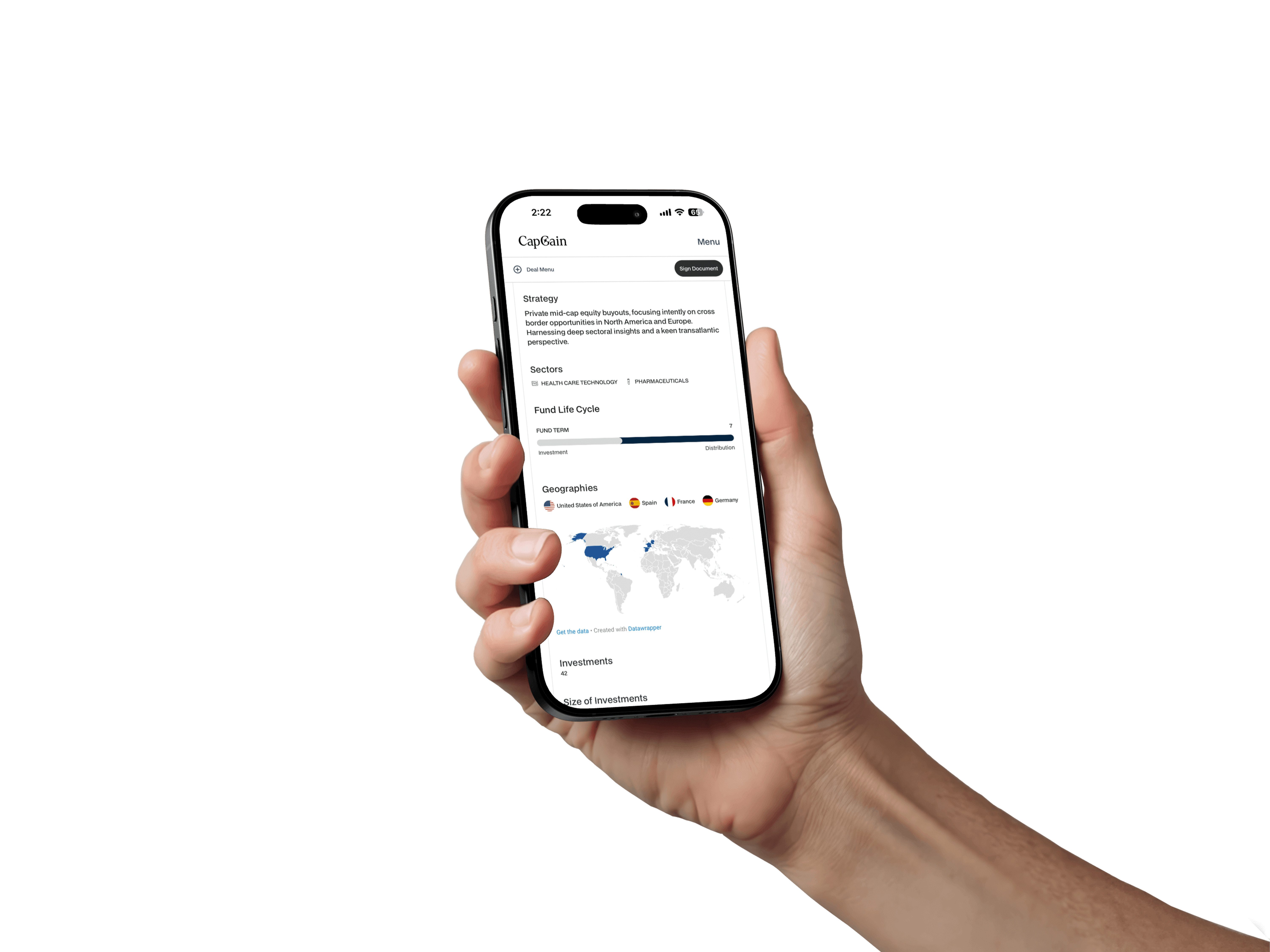
We’ve built a platform
designed around you.
CapGain makes it easier for qualified investors to explore private market opportunities through a single digital gateway.
Access is restricted to Professional Clients as defined by the DFSA. Investments carry risk, and capital is not guaranteed.
Why investors look to private markets
Private markets have traditionally been the domain of institutions and the ultra-wealthy — for good reason. They offer exposure to parts of the economy public markets can’t reach, and their structure allows for active, long-term value creation.
Access to high-growth opportunities
Private markets capture businesses early — before they go public — where growth potential and value creation are greatest.
Active value creation
Fund managers don’t just buy and hold; they actively build, restructure, and grow portfolio companies to unlock returns.
Diversification
and resilience
Private assets often move differently from public markets, helping smooth volatility and protect long-term portfolios.
Long-term
alignment
With longer investment horizons, private funds focus on fundamental growth, not quarterly earnings pressure.
Information advantage
Direct access to management teams and operational data allows for deeper due diligence and strategic oversight.
We’ve built a platform
designed around you.
CapGain makes it easier for qualified investors to explore private market opportunities through a single digital gateway.
Access is restricted to Professional Clients as defined by the DFSA. Investments carry risk, and capital is not guaranteed.
Why investors look to private markets
Private markets have traditionally been the domain of institutions and the ultra-wealthy — for good reason. They offer exposure to parts of the economy public markets can’t reach, and their structure allows for active, long-term value creation.
Access to high-growth opportunities
Private markets capture businesses early — before they go public — where growth potential and value creation are greatest.
Active value creation
Fund managers don’t just buy and hold; they actively build, restructure, and grow portfolio companies to unlock returns.
Diversification
and resilience
Private assets often move differently from public markets, helping smooth volatility and protect long-term portfolios.
Long-term
alignment
With longer investment horizons, private funds focus on fundamental growth, not quarterly earnings pressure.
Information advantage
Direct access to management teams and operational data allows for deeper due diligence and strategic oversight.
We’ve built a platform
designed around you.
CapGain makes it easier for qualified investors to explore private market opportunities through a single digital gateway.
Access is restricted to Professional Clients as defined by the DFSA. Investments carry risk, and capital is not guaranteed.
Important Information
CapGain does not make investment recommendations and no communication, through this website or otherwise should be construed as a recommendation of any security. Alternative investments in private placements are highly illiquid, speculative, and involve a high degree of risk. Past performance is not indicative of future results. Investors may not get back their money originally invested and those who cannot afford to lose their entire investment should not invest. Prior to investing, carefully consider the respective fund documentation for details about potential risks, charges, and expenses. The value of an investment may go down as well as up. An investment in a private equity ("PE") fund or investment vehicle is not the same as a deposit with a banking institution. Investors receive illiquid and/or restricted membership interests that may be subject to holding period requirements and/or liquidity concerns. Investors who cannot hold an investment for the long term (at least 10 years) should not invest. In the most sensible investment strategy for PE investing, PE should only be part of your overall investment portfolio. The PE portion of your portfolio may include a balanced portfolio of different PE funds.
The CapGain platform may be accessed by certain international investors globally, including ‘Professional Investors’ (as defined by the DFSA) in the UAE, on a cross-border basis after appropriate checks and confirmation of their status. CapGain’s products are not suitable for retail investors in the UAE.